The Bmbed topolgy is quite simple. Every microcontroller runs a frame application which already includes some general functions like access to interfaces, inputs/ outputs, persistent data etc. Furthermore the Bmbed network API is always available to link the Bmbed components very easily e.g. with a PC. Almost every Bmbed driver is programmed as "bare metal". This gives you a very high transparency between source code and hardware.
The Bmbed framework also contents a bootloader which allows to update the application through the network e.g. with a PC.
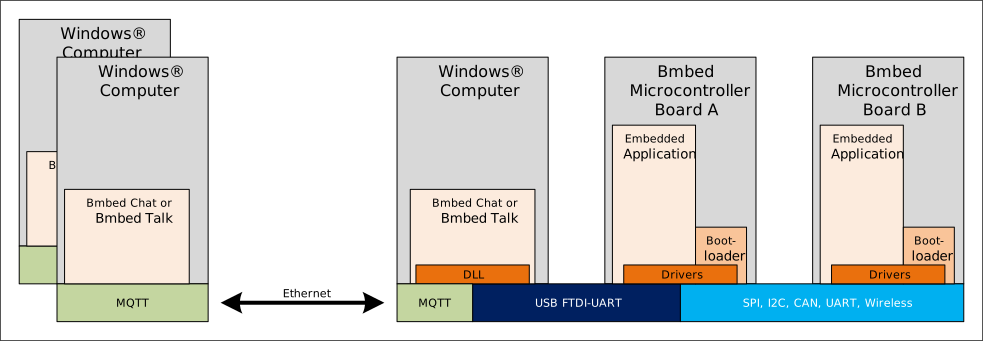
The Bmbed network connects different boards/ microcontrollers with a Windows PC. The Bmbed High-Level-Protocol allows to communicate with equal rights (peer to peer).

Every network node represents a physical computer unit (e.g. PC, microcontroller, evaluation board, etc.) with a unique node identification number. Every node itself can own logical subnodes. All these nodes are visible in the entire Bmbed network.
IoT (Internet of Things) is that huge IT slogan. You hear everything about IoT e.g. that every toothbrush will be connected to the internet and it can be controlled from the other side of the world.
Shure that is feasible and this example shows the security problem with IoT and embedded devices.
Embedded devices with enough power (e.g. Cortex-A7 and 1GByte RAM) can be protected well against cyber attacks from outside. But smaller devices (e.g. Cortex-M0) doesn't have enough computing power for a sufficient protection. And these are existing in huge quantity.
Bmbed handles IoT restrictively: